Two-Column Proof in Geometry (Definition & Examples)

Two-column proof definition
A two-column proof in geometry is one of three primary ways to demonstrate the truth of a mathematical statement. It remains one of the most reliable methods, since it compels the geometrician, or at least the geometry student, to back up every claim with real evidence.
| Aspect | Details |
|---|---|
| What it is | A logical argument presented in a two-column table, pairing statements with reasons |
| Purpose | To prove a geometric statement by linking every claim to supporting evidence |
| Alternative proof types | Paragraph proof, Flowchart proof |
| Used in | High school geometry, college-level mathematics, standardized assessments |
Among the many methods available to mathematicians are proofs, or logical arguments that begin with a premise and arrive at a conclusion by delineating facts.
Writing a proof is a challenge because you have to make every piece fit in its correct order. Most geometry coursework revolves around three types of proof:
Paragraph proof
Flowchart proof
Two-column proof
Paragraphs and flowcharts can lay out the various steps well enough, but for purity and clarity, nothing beats a two-column proof.
A two-column proof uses a table to present a logical argument, assigns each column a single job, and then the two columns work in lock-step to take a reader from premise to conclusion.
Structure in two-column proofs
A paragraph proof tells a story, with each fact and reason laid out in sequential order. That means you have to be extremely organized and may need to rewrite the paragraph multiple times before getting it right. A flowchart proof can be hard to follow, but at least it separates the mathematics from the reasoning in a clear way.
| Element | Description |
|---|---|
| Left column (Statements) | Contains only mathematical statements (e.g., "Side PI = Side NK") |
| Right column (Reasons) | Contains only justifications (e.g., "Given," a theorem, or a definition) |
| Numbering | Every step is numbered so each statement aligns with its corresponding reason |
| Conclusion | The proof ends when the concept has been fully demonstrated |
Only a two-column proof explicitly places the mathematics on one side (the first column) and the reasoning on the other side (the second or right column). As long as you keep the two sides lined up, you cannot fail to move the reader from one premise to the next, and finally to the conclusion.
The structure of a two-column proof must follow four basic precepts:
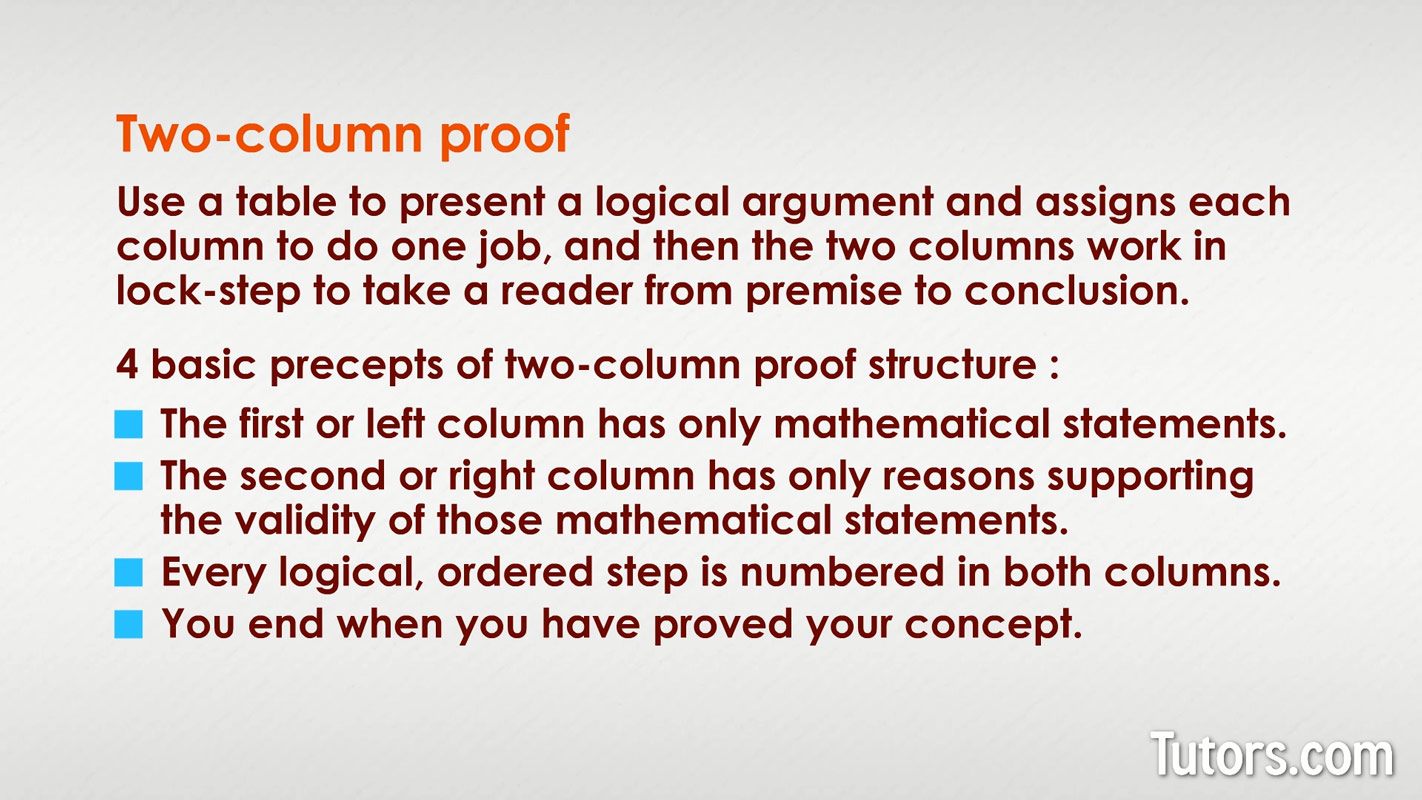
The first or left column has only mathematical statements, like "quadrilateral PINK is a parallelogram" or "side PI = side NK."
The second or right column has only reasons supporting the validity of those mathematical statements, like "Given," or "If the opposite sides in a quadrilateral are the same length, then the figure is a parallelogram."
Every logical, ordered step is numbered in both columns, so Step One on the left is supported by Step One on the right.
You end when you have proved your concept.
How to solve two-column proofs
A two-column proof is only a structure, like a skeleton. You need five tools to work your way from premise to conclusion and complete the proof:
| Tool | Purpose |
|---|---|
| Givens | State what is provided in the diagram or problem setup |
| A diagram | Clarifies the geometric figure; draw one if none is provided |
| Foundational knowledge | Thorough understanding of theorems, postulates, definitions, and vocabulary |
| Reasoning and thinking skills | Logical thinking to connect arguments; patience when hitting dead ends |
| Order | Proceed logically and concisely from one idea to the next until reaching the conclusion |
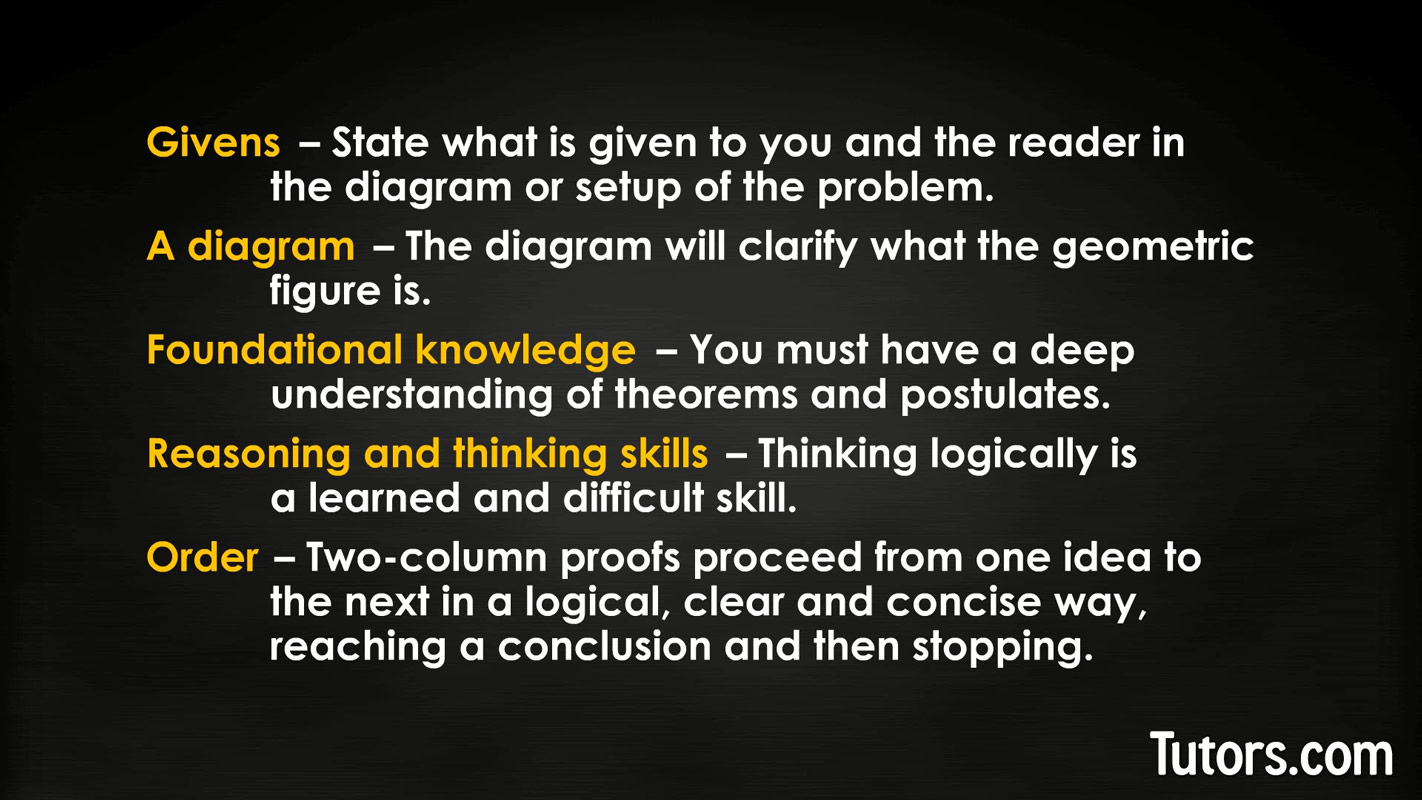
Givens – State what is given to you and the reader in the diagram or setup of the problem
A diagram – The diagram will clarify what the geometric figure is; if no diagram is provided, draw one!
Foundational knowledge – You must have a deep understanding of theorems and postulates so you can apply them quickly and logically; without understanding definitions, vocabulary, and relationships among geometric figures, you cannot move from argument to argument
Reasoning and thinking skills – This is no royal road; you may start out, run into a mental wall, and have to start again; thinking logically is a learned and difficult skill, so be patient and give yourself thinking time
Order – Two-column proofs proceed from one idea to the next in a logical, clear, and concise way, reaching a conclusion and then stopping
How to write two-column proofs
You can write a two-column proof by drawing a horizontal line at the top of a sheet of paper and a vertical line down the middle. Label the left side "Statement" and the right side "Reason." Say you are asked to prove the Isosceles Triangle Theorem, which states that if two sides of a triangle are congruent, their opposite angles are congruent.
| Step | Action |
|---|---|
| 1. Setup | Draw a two-column table labeled "Statement" and "Reason" |
| 2. State givens | Write the given information as your first statement(s) |
| 3. Build logically | Add statements supported by theorems, postulates, or definitions |
| 4. Conclude | End with the statement you set out to prove |
| Typical length | Most proofs require fewer than 10 steps |
You will be given some information, like △WHZ has Side HW ≅ Side HZ, making it an isosceles triangle.
You are asked to prove ∠W ≅ ∠Z.
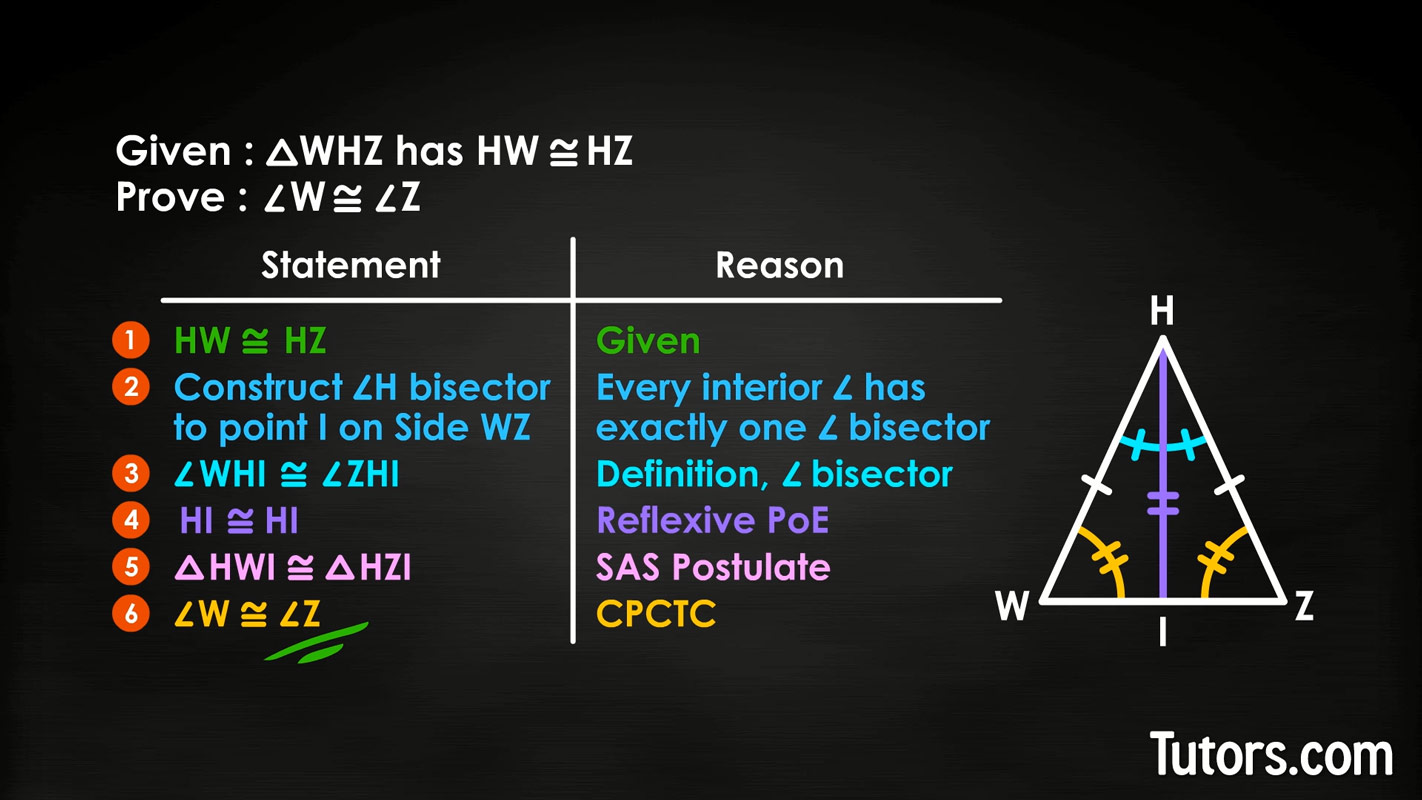
| Statements | Reasons |
|---|---|
| HW ≅ HZ | Given |
| Construct ∠H bisector to point I on Side WZ | Every interior ∠ has exactly one ∠ bisector |
| ∠WHI ≅ ∠ZHI | Definition, ∠ bisector |
| HI ≅ HI | Reflexive Property of Equality |
| △HWI ≅ △HZI | Side-Angle-Side Postulate |
| ∠W ≅ ∠Z | Corresponding parts of congruent triangles are congruent (CPCTC) |
This was a five-step proof. Most geometry proofs can be completed in fewer than 10 steps. If you find yourself going past seven or eight steps, you may be heading down an inefficient or incorrect path. How can you help yourself?
Two-column proofs & reasoning
One strategy for working through a two-column proof is to first consider the end: what is it you are asked to prove? Without worrying about a numbered item, put that down as the statement for the last position. Consider the reason for that statement; what would you need to prove that?
| Strategy | Description |
|---|---|
| Work backward | Start with the conclusion and determine what reasons would support it |
| Draw an accurate diagram | Identify complementary/supplementary angles, right angles, and equal sides |
| Keep references handy | Use postulates, theorems, definitions, and properties (including algebraic properties of equality) |
| Rearrange freely | Do not force a proof that leads to a dead end; restructure as needed |
| Break it down | For complex proofs, find smaller, more easily provable chunks within the problem |
Another important detail is to draw a diagram or picture that exactly matches the given information. See what else is revealed by the given information, like complementary or supplementary angles, right angles you may not have noticed, or equalities of angles or sides.
Keep your reasons handy, especially if you have not memorized a large collection of axioms and theorems. These can be postulates, other theorems, definitions, or properties. Remember that properties can come from beyond geometry, too, like properties of equality.
Be willing to rearrange order. Do not get so attached to your proof that you persist in trying to "make it work" if it has led you down a blind path.
Start simple. If you are struggling with a complex proof of a tough problem, see if you can find smaller, more easily provable chunks within it.
The surest way to get better at two-column proofs is to practice writing them.
Showing off
Once you are truly confident in your ability to write two-column proofs, you can show off a bit by writing Q.E.D. at the end. This is the abbreviation for the Latin phrase, quod erat demonstrandum, meaning "that which has been demonstrated." It signals to your mathematics teacher and others that you have finished and completed the proof. Some modern textbooks and digital proof tools in 2026 also use the tombstone symbol (∎) in place of Q.E.D., but the meaning is the same.
Lesson summary
Now that you have worked through both columns from top to bottom of this piece, you are able to understand and appreciate the value of proofs in mathematical reasoning. You can recognize and name the three kinds of mathematical proof (paragraph, flowchart, and two-column), identify the elements of two-column proofs, and write your own two-column proof. Mastering this structured approach to geometric reasoning builds critical thinking skills that extend well beyond the classroom.